
Molecubes makes PET imaging small enough for every lab
Client: Molecubes · Sector: Medical imaging
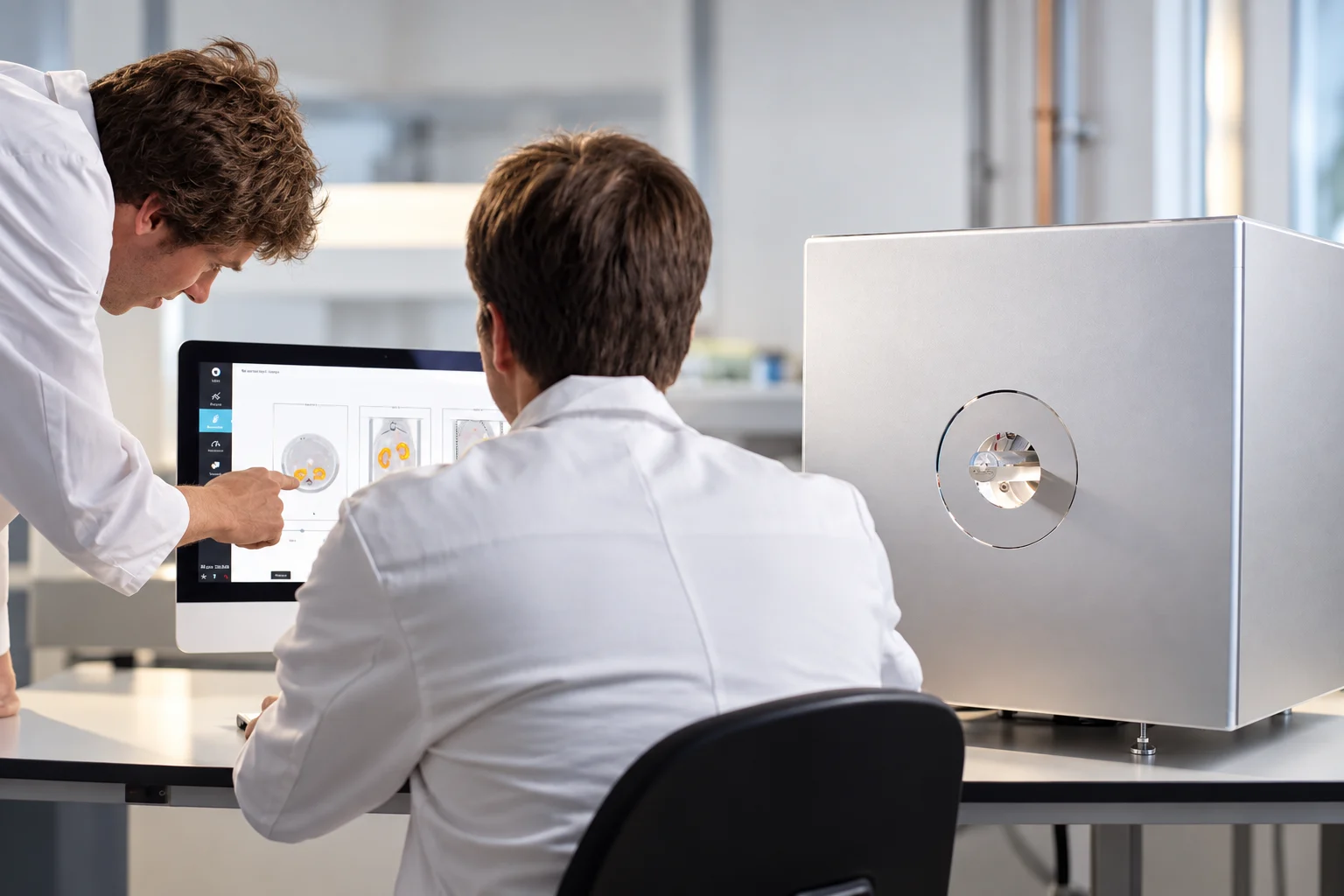
Preclinical imaging is a standard step in the research into new medicines. With PET, researchers can see in a living mouse or rat where a substance goes and what it does, in the brain, the heart or a tumor. For a long time, those scanners were large, expensive and complex. They stood in specialized centers, and anyone who wanted to run a study had to wait their turn there.
Molecubes set out to change that, with scanners that fit on a lab bench, are easy to operate and still deliver research-grade images. The company was co-founded in Ghent in 2016 by Pieter Mollet, now at Invisto. In 2022 it was acquired by Bruker.
At Molecubes, Pieter built the β-CUBE, the PET scanner in the product line, from the detector to the software the researcher works with.
The result
PET on a lab bench. With its small footprint, the β-CUBE fits in a small lab, without dedicated infrastructure, and there is no longer any need to turn to an imaging center.
Sub-millimeter resolution. The scanner reaches a spatial resolution below 850 µm and a peak sensitivity above 12%. That makes small structures visible, such as individual brain regions of a mouse.
Modular with CT and SPECT. The β-CUBE works on its own or together with the X-CUBE (CT) and the γ-CUBE (SPECT), on a shared multimodal bed. A lab can start small and expand later.
A product that found its way. More than a hundred CUBES are installed worldwide at research groups and pharmaceutical companies. With the acquisition by Bruker, the technology ended up with one of the major players in scientific instrumentation.
What was built
A PET scanner is a chain in which every link determines the next. How accurate an image becomes depends as much on the crystals in the detector as on the algorithm that reconstructs the image. That is why the whole chain was developed as one.
Detectors made of monolithic crystals
Most PET scanners use detectors made of thousands of small crystal pixels. The smaller those pixels, the sharper the image, but also the more expensive and fragile the detector. The β-CUBE uses monolithic LYSO crystals, read out by silicon photomultipliers (SiPMs). The detectors were designed and built in house.
Event positioning on the GPU
In a monolithic crystal, there is no pixel that tells you where a photon struck. That position has to be calculated from the way the light spreads across the sensors. Algorithms were developed that do this for every event. They run on the GPU, so they can keep up with the large stream of events. It is exactly that accurate positioning that makes the sub-millimeter resolution possible.
System integration and assembly
Detectors, electronics, mechanics and software have to fit in a housing no bigger than a small cabinet. The five detector rings, the readout and the bed were integrated into one system. That also included the assembly of the systems themselves.
Image reconstruction in C++ and CUDA
The actual image is calculated from the measured events with OSEM, an iterative reconstruction algorithm. The heaviest step is ray tracing: working out, for every event, which voxels in the image the path of the photons passes through. The reconstruction was written in C++, and the ray tracing was accelerated with CUDA on the GPU. That made a research-grade image available in a workable time.
A reconstruction server
Reconstructions are heavy computing tasks, and a lab runs many of them. A reconstruction server in Django manages them: it queues reconstructions, tracks them and stores the results. The researcher does not have to wait at the scanner, and reconstructions can be run again later with different settings.
One interface for all CUBES
Each CUBE runs a Linux back end that controls the hardware. The researcher sees none of that. The interface is a Qt application on an iMac that talks to the β-CUBE, the X-CUBE and the γ-CUBE over XML-RPC. From there, the researcher plans a scan, follows the acquisition and views the images, in the same way for each of the three modalities.
What Invisto takes from it
The β-CUBE brought together product design, system instrumentation and integration, complex algorithms for image processing and reconstruction, and full-stack software in a single product. Our customers ask for that same combination today, whether it is a measuring instrument, a device with a camera and AI at the edge, or a system that has to turn raw sensor data into usable information.