SOM vs custom PCB: which hardware architecture should you choose for an embedded Linux product?
When you develop an embedded Linux product, you have to decide early on how the processor gets onto the board. You can mount a System-on-Module (SOM) on your own carrier board, or design the entire processor architecture yourself on a single PCB. A SOM lowers development risk and gets you to market faster. A fully custom board can become more attractive at higher volumes, with a strict form factor or specific I/O.
Which way you go rarely comes down to the price of a single component. It is about the total cost, the lifecycle, the software support and how much risk you want to carry in the product.
What exactly is different
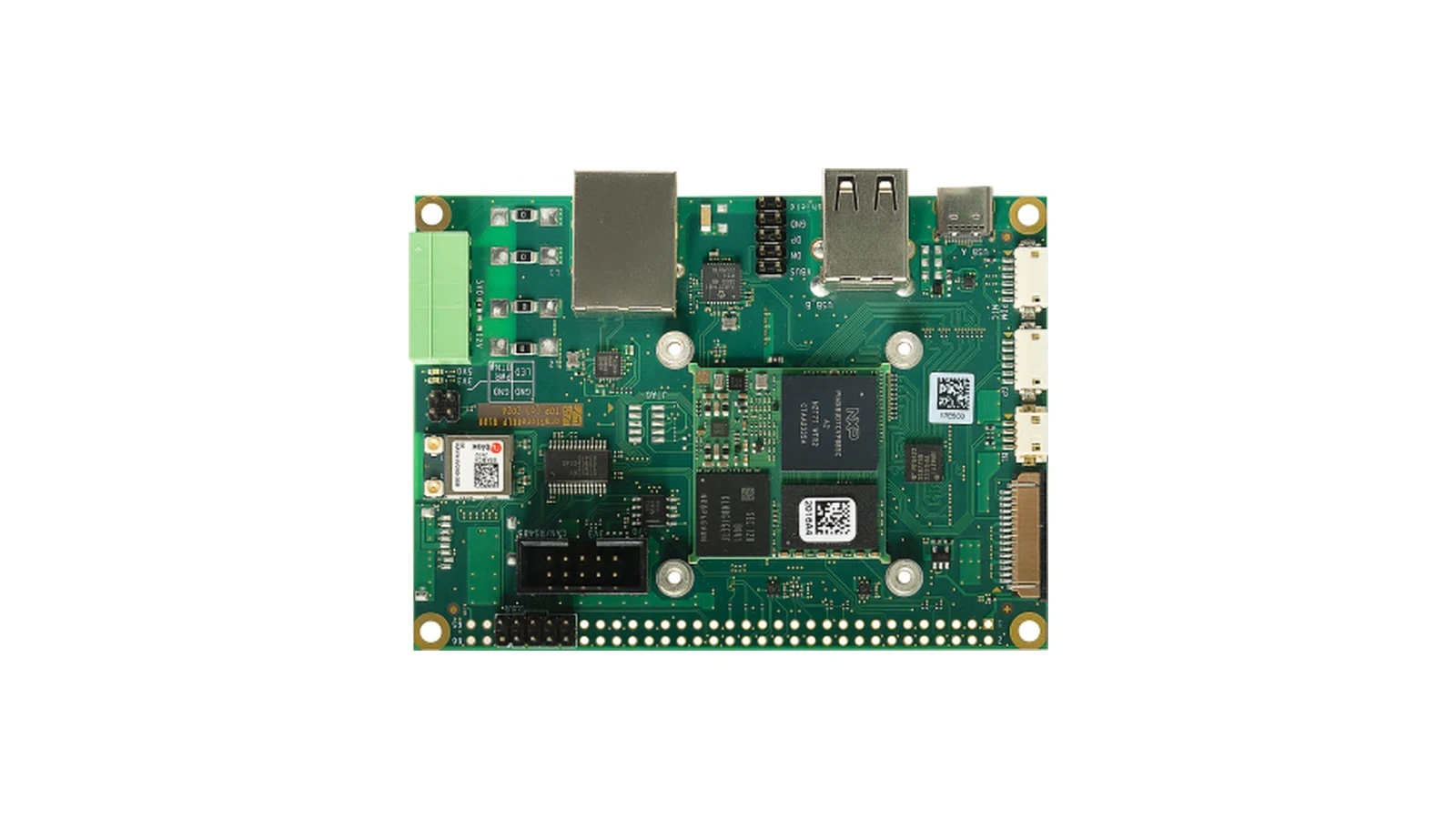
In a SOM architecture, the application processor, the RAM, often the eMMC too, and the complex power and high-speed infrastructure sit on a separate module. Your own carrier board holds what is specific to your product: the I/O, the power supply, the connectors and the interfaces. With a fully custom PCB you integrate the processor, the DDR memory, the storage, the PMIC and all interfaces directly on your own board.
Why a SOM is so attractive
Putting a modern application processor on your own PCB is a lot more complex than a microcontroller design. The DDR layout, power sequencing, PMIC configuration, bootstraps, eMMC, signal integrity of the high-speed signals and the thermal design all have to work together. A SOM takes a large part of that work off your hands. In concrete terms, that usually gives you the following:
- You develop faster and need fewer hardware iterations.
- Software work can often start on a development kit while the carrier board is still being designed.
- Processor, RAM, storage and power architecture have already been validated as a combination.
- You have less high-speed PCB layout of your own, and therefore less technical risk.
- The SOM vendor often supplies a BSP, a bootloader configuration and Yocto integration.
- Within the same product family it is easier to offer variants with a different CPU, more RAM or more storage.
So with a SOM you buy hardware, and along with it a piece of engineering, validation and lifecycle management.
The downside: a higher cost per device
You pay for that lower NRE and faster development through a higher price per device. The SOM vendor builds its PCB, connectors, validation, inventory management and margin into every module. At low and medium volumes that is often an excellent trade. As volume grows, though, that recurring extra cost can start to outweigh the one-off engineering cost of your own processor board.
A simple calculation
Suppose a SOM solution costs 80 euros more per device than an equivalent fully custom design. At 100 devices a year, that costs you 8,000 euros a year. At 20,000 devices a year it adds up to 1.6 million euros a year, or 16 million over ten years. The exact figures vary widely from platform to platform, but the principle stays the same.
Volume changes the economics. A SOM mainly lowers engineering cost and risk, a custom PCB mainly lowers the recurring product cost.
Look at the TCO, not just the BOM
There is no break-even volume that applies to every product. A fair comparison takes into account at least the PCB complexity, the number of engineering hours, prototypes, EMC iterations, certification, production volume, expected lifetime, the risk of a redesign, software maintenance and what it is worth to reach the market earlier.
| Cost component | SOM + carrier | Custom PCB |
|---|---|---|
| Initial engineering | Lower | Higher |
| Prototype risk | Lower | Higher |
| Cost per device | Usually higher | Potentially lower |
| Responsibility for a redesign | Partly with the SOM vendor | Fully in-house |
| Time-to-market | Usually faster | Usually slower |
Developing hardware and software in parallel
A big advantage of a SOM is that the software doesn’t have to wait for your final board. The kernel, the Yocto image, the Qt or other application software, the communication and the update infrastructure can often be developed on a development kit or an evaluation board for the SOM. Meanwhile, the carrier board design, the mechanics and the production preparation simply carry on.
For a new product, validating or launching a few months earlier can matter much more economically than saving a few tens of euros on the BOM.
Lifecycle and supply chain
A SOM doesn’t remove the lifecycle risk. Part of it shifts to the module vendor. That is an advantage if the vendor actively tracks component changes and guarantees long availability. At the same time you become dependent on an extra party. A few questions to ask up front:
- How long does the vendor guarantee the module will remain available?
- How are changes to RAM, eMMC, PMIC or new PCB revisions managed?
- Will the BSP remain compatible and maintained over the full lifetime of your product?
- Are there pin-compatible alternatives or migration paths?
- What happens when the module goes EOL?
A processor with a long lifecycle doesn’t automatically mean the SOM it sits on stays available for just as long.
Software is part of the hardware choice
With embedded Linux you never choose just a processor or a module. In practice you choose a combination of hardware, bootloader, kernel, BSP, Yocto layers, security support and an update path. A technically strong SOM with a poorly maintained BSP can therefore still be a bad choice for your product.
For industrial products it pays to look, even before hardware selection, at upstream Linux support, the quality of the vendor BSP, the Yocto release policy, secure boot, OTA updates, SBOM and CVE tracking, and how dependent you become on software that only that vendor supplies.
EMC and certification
A SOM reduces the chance of problems with DDR and other high-speed signals, but it doesn’t make your end product compliant by itself. The carrier board, power supplies, cables, display, enclosure and external interfaces together determine the EMC behavior of the complete device. Even with a certified or pre-tested module you still have to validate the end product.
When does fully custom become interesting?
There are a number of situations in which your own processor board is worth the extra engineering:
- High volumes. The BOM savings can pay back the higher NRE.
- A strict form factor. A SOM, the board-to-board connector and the carrier board together take up extra area and height.
- Specific I/O. Your application needs an unusual combination of interfaces, PHYs, an FPGA, or camera and display connections.
- Thermal design. You want complete freedom over where the processor and memory sit and how the heat is carried away.
- Control over the supply chain. You want to buy components directly and qualify alternatives yourself.
- A very long lifecycle. You want redesigns and component migrations fully in your own hands.
A SOM first, custom later
For many new products the choice doesn’t have to be final. A first generation can start with a SOM and your own carrier board, so you move quickly to prototypes and series production. Once the product is proven and volume grows, a next hardware generation can integrate the processor architecture directly on the board.
By then the main uncertainties are gone. You know which I/O you need, RAM and storage have been validated, the thermal load has been measured, the EMC risks are visible and, most importantly, you have a much better idea of the actual sales volume.
Decision matrix
| Factor | SOM + carrier | Fully custom |
|---|---|---|
| Development cost | Lower | Higher |
| Time-to-market | Faster | Slower |
| Hardware complexity | Lower | Higher |
| Unit cost | Higher | Lower at sufficient volume |
| Low and medium volumes | Often a strong fit | Harder to justify |
| Form factor freedom | More limited | Maximum |
| Design risk around the processor | Mainly with the SOM vendor | Your own responsibility |
| Control over the supply chain | Partly dependent on the vendor | More direct control |
| BSP and software | Often a baseline available | More integration of your own |
How we look at it
At Invisto we look at the complete product architecture, beyond just the processor. Expected volumes, product lifetime, mechanical constraints, the display, connectivity, Linux support, security and the update strategy together determine which hardware architecture makes sense.
For many industrial products, a System-on-Module with your own carrier board strikes a good balance between control, development speed and risk. At higher volumes or for highly optimized products, a fully custom processor board can eventually become the better architecture, both technically and economically.
Our X Series panel PCs are built this way. We design the application processor or SOM, our own carrier board and mechanics, a managed embedded Linux stack and the update and security strategy as one product.